How I Brew


For existing members, hi again and I hope everyone has had a chance to dig into (and enjoy) the coffees I delivered last weekend. For new members, thank you for joining and I look forward to delivering some excellent coffees next month! For today’s fairly lengthy but essential discussion, I just wanted to share what some of my go-to starting brewing recommendations are. 


“New” equipment – I recently acquired an Acaia scale and have been using the app to track how I am brewing and I have to say they are way better for home use than I expected. I never used them to their full potential in a service setting, cause who has time to get the app set up and save a brewing print in the middle of a rush? This is not necessarily important to brew great cups at home, but it certainly helps tracking your brewing history.

WATER – I hate talking about water, but I do have a lot of opinions on it. Here we go. The official SCA standard for water hardness is 50-175 ppm of CaCO3, which is a pretty wide range. What this means is don\’t use distilled water (0 ppm) but also don\’t use city tap water if your city has bad water. Chicago is actually at 148 ppm so technically it’s okay to use; this is because those giant industrial-ass looking machines way out in Lake Michigan are positioned far enough out to not collect the dirtier water closer to the shore. In general though, if you use any sort of filter, your water is going to end up in the recommended range. However, the most important thing is that if this number remains constant, your brew parameters will adjust around it, which is one of the many reasons I may use a different ratio with my PUR filter than someone with a full on reverse osmosis system, and even different again than someone putting their trust in the great Chicago Department of Water Management. 

TEMPERATURE – Now while I have absolutely zero scientific evidence to back this up, in my experience the worse your water filtering is, the lower your temperature needs to be. At home, I use a water temperature of 92-93 C. While working at Purple Llama, I needed to use a higher water temperature of 95 C because the reverse osmosis system kept the water at around 60-70 ppm. Higher water temperature is able to extract more flavor compounds/acids from ground coffee; however, sometimes it takes undesirable acids from the grounds, especially when combined with a higher water hardness. A lower temperature with higher water hardness is how we get around undesirable flavors. Especially in coffees like the frozen cherry, which I\’m sure at a high extraction is going to give you some funky flavors.

RATIO/GRIND IN RELATION TO TDS – Next is a tricky topic that I know people in the coffee establishment won\’t agree with…how the TDS [total dissolved solids] reading from a finished brew only matters in terms of repeating a successful brew method. I was once told by a very pro-establishment coffee person that a finely ground, faster brew time and a coarser, slower brew time would make the exact same flavor coffee. This is just not true. They will have the same TDS theoretically, but based on experience, the acids and flavor compounds will be very different. Some coffees need to be ground coarser and brewed slowly (more pouring increments/pulses) and some coffees benefit from a faster brew time and finer grind. In my previous and future posts, you will see me mention a faster or slower brew time with associated grind settings. I am basing this off of how I experience tasting each coffee at different particle size and brew time. So, here’s an experiment for you: next time you make coffee, try going a little bit finer and try to complete all pouring at least 30 seconds faster than you normally do. This can be done by pouring faster and/or taking less pulses; the latter means that your pour volume per pulse should increase. Record what your drop time is and take a long pondering trip into the world of flavors. Then, next time go a couple clicks coarser than normal and do the opposite of the previous (finer grind) brew; either pour slower and/or add more pulses with less water volume per pulse. Compare this drop time to the previous faster brew. This slower brew could be about a minute longer than the faster brew. Now taste the difference. In general, the faster brew will be more delicate/tea-like with more acidity. The slower brew will have more body and more sweetness, with less pronounced fruit notes. If you’re using an immersion brew method (Clever, French Press, AeroPress) just decrease/increase steep time and disregard all mention of pulses. The differences in cup quality should still be present. So if you’ve tried the experiment for yourself, you have now tasted two drastically different tasting brews that have probably very similar TDS. Which brings me back to my point of all this: don\’t shoot for a TDS when you make your coffee. I tend to use the \”faster\” brew method for coffees with a profile similar to washed Ethiopian coffees or Kenyan coffees; something that is tasty because of brighter flavors. Sometimes this can sacrifice sweetness, however, the complexity of citrus notes and tropical fruit can become more clean and clarified. The \”slower\” brew method is what I use for coffees like the frozen cherry natural I delivered last month from Junto. Sometimes with coffees like that, if you grind too fine and brew too fast you extract the high acidity flavors and those flavors from a natural can be fermenty and iodiney. Thus, a coarser grind and slower pour will extract the desired big sweet flavors.

As always, if you have any questions/thoughts about any of this please feel free to leave a comment that I can reply to. Someone else might have the same question so better to leave a comment to help an all-around understanding as a group! 

May Coffee: Junto\’s Colombian Coffee Celebration

Happy Sunday everyone!


By now you have received your very first coffee order delivered by myself or the lovely Adam Hirzel. For the first month, you may have noticed you received only Colombian coffees. Single-bag subscribers and multi-bag subscribers all received the frozen cherry natural and then the black honey. Both of these coffees come from the same producer in Colombia, Felipe Trujillo of the La Ventolera farm in the Antioquia region. From many of you, I heard the same reaction that I also had when first hearing \”frozen cherry natural\”. It is a very experimental process that I had never heard of before either. Basically, they start with a Castillo variety (common varietal in Colombia) grown at 2000 meters. After harvesting, the cherry is processed like a normal natural and fermented for 400 hours. Next is where it gets a little funky… the fermented cherries are packed in sealed plastic tanks and kept at -18° C for three days. This process in unheard of in my world at least – cutting off a natural process to do a frozen anaerobic process. The combination of the two processes creates an extremely controlled natural fermentation, keeping the nasty natural flavors from taking over. This coffee is clean, excessively sweet, and fairly acidic. Brownies on the nose, flavors of cherry ice cream, and a lingering aftertaste of chocolate chip cookies.. Here is how I brewed it: 

  1. I used a 16.5:1 ratio, and went very April Coffee Roasters style on it, brewing just 12.5 grams of coffee with 205 grams water.
  2. Grind this one EVEN finer than the black honey listed below. By one or two clicks.
  3. For v60, I bloomed with 2x the dry dose, and then poured to 70 grams water, and from the start of this pour, I waited 30 seconds, until 1:10, then poured to 140 grams, then waited until 1:40, and poured to 205 grams. My brew time was 2:30, although if I would have poured slower and extended the final brew time, I feel more flavors would have come out.
Frozen Coffee Cherres being removed from -18° C sealed tanks

Next is the black honey coffee that many of you also received. This varietal is Yellow Colombia, a slight variation on the also common Colombia varietal. The trees were grown almost as high as the frozen cherry, at 1900-1950 MASL, and then harvested once cherries are ripened. What is interesting about this farm, is that not all cherries are picked upon perfect ripening. For this coffee, 70% of the lot was harvested at peak ripeness, 20% over-ripe (imagine a wilting strawberry), and 10% under-ripe. Again, this is not something that is super common, and definitely not something that is commonly shared. This coffee has more tropical berry notes, chocolate, and tartness. Here is how I brewed it:

  1. I used a 16:1 ratio, using 20 grams of coffee, and 320 grams of water. 
  2. Grind slightly finer than your normal \”go-to\” starting grind. 
  3. I used a v60, and after blooming, I used two pours. 50 gram bloom, then poured to 200 grams, then poured to 320 grams. My brew time was 2:45. 

    From both of these coffees, I can tell that what is happening at Trujillo\’s farm is very advanced. If anyone remembers when I brought on a coffee from Trujillo roasted by Workshop Coffee (London), it was super sweet, and just a washed Colombia varietal coffee. Junto was able to work with him and find these two rare, unique coffees and I am so happy I was able to share them with you for the first month. Lastly, a few of you also received a coffee from the Copa Suacena competition that the Junto owner/roaster took part in judging. It is a competition from producers in Sauza region, and Junto was able to get coffees from 1st-5th place. Currently, 5th and 4th were available. 4th place was much more expensive and I would have had to do a special order for people interested. I talked with the roaster, and they told me that the 5th place actually had more fun flavor notes, reminding them more of a washed Ethiopia, with tasting notes of Currant, Lime, and Rooibos. Whereas the 4th place coffee is a much more classic Colombia, with more brown sugar and chocolate notes; what I would refer to as \”a great basic\”. I was not able to personally try the 5th place coffee I delivered, but please comment below if you received it and found a great way to brew it. Likewise, please feel free to comment on ANY of the coffees shared this month and your thoughts on tasting, brewing, or even what worked/didn\’t work for making this subscription service seamless.

    – Dylan 

    Born out of the Pandemic…Stimulus Coffee Club

    \”A new start to a life without coffee, no more cracked fingertips, incessant seasonal cold as a result of direct customer service. A retirement from coffee finally!\” Is what I thought the LAST time I retired from coffee. I was fresh off of my national championship and was feeling pretty good. Through a collection of fumbles, missteps, and underestimates, I ended up right back in the seed of the coffee cherry, serving coffee at Purple Llama. I was selecting which coffees to serve the community and the best way to do that. When the shop decided to permanently close last month, I found myself thinking the same thoughts I had last time retiring from coffee. These thoughts lasted nearly 12 hours.


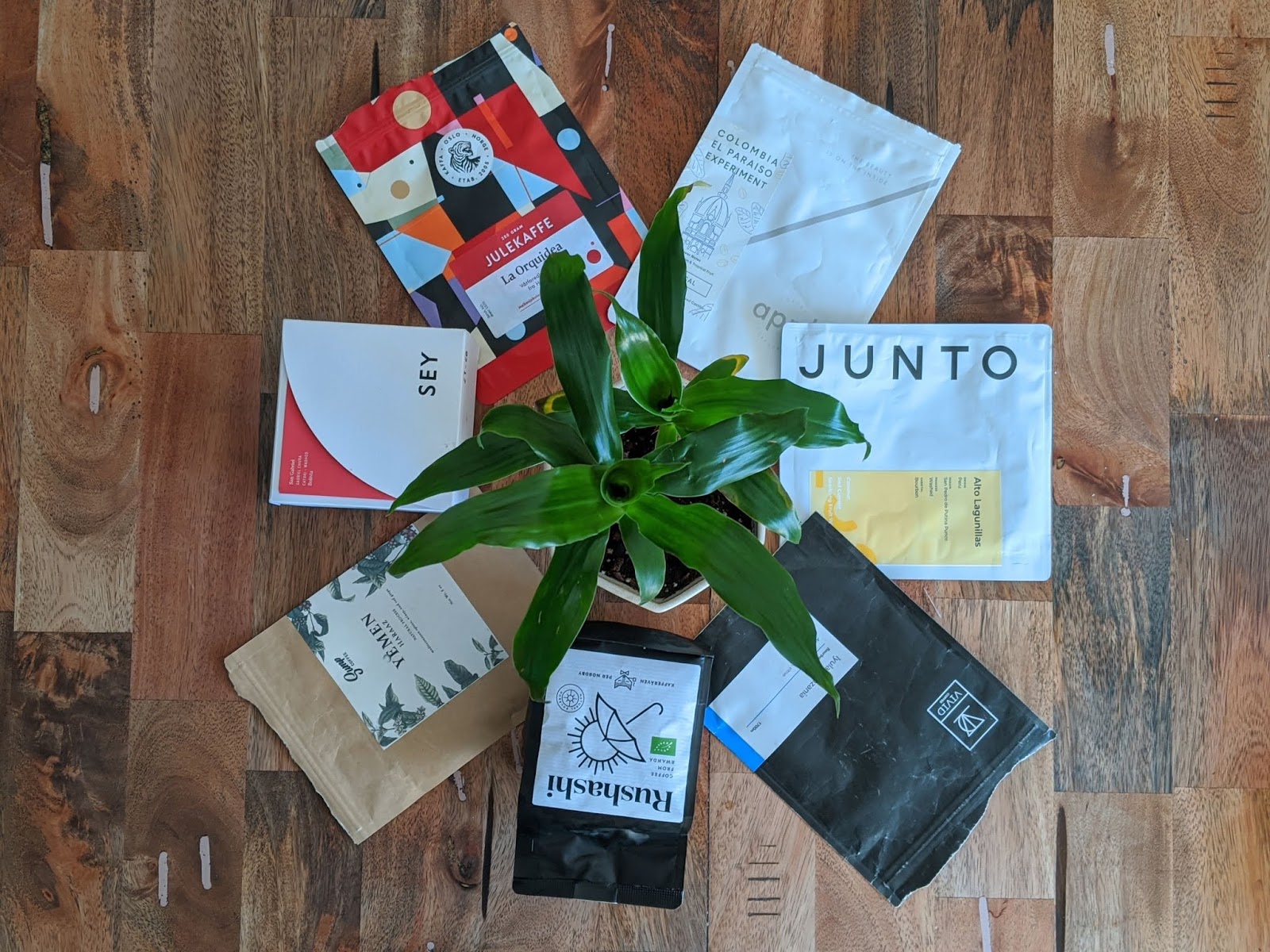
    Welcome to my coffee subscription. This is a place where coffee nerdery is encouraged, and where we become better at tasting coffees and discussing differences. I am calling this a club, as I intend to involve each person (regardless of current taste preference, brewing method, and knowledge level) to engage with me and others to learn as much as they can and brew each coffee I share to the best of their abilities. 

    I understand that some people like the autonomy about going to a store and hand selecting which beans they would like to buy. I certainly do. And I\’ll be honest, the coffee you receive from this subscription will not give you that same instant gratification. But here is what it will have: hours of research selecting coffees that were purchased from roasters based off of award-winning scoring, interesting/complex flavor profiles, a highly sustainable trade relationship AND a promise that the coffee was roasted by someone who respects the growth and processing of the coffee so much that they refuse to impart any of their own trademark flavors on the coffee, only preserving and bringing out the potential flavors that developed during growth and post-harvest processing. I don\’t want you to miss that going to the store feeling… so instead, I want you to anxiously anticipate what newest package of precious beans will arrive at your doorstep for you to brew the next morning as you start a new day.


    I look forward to providing everyone involved with coffees that get me excited and will hopefully share that excitement to the subscribers. To those who have subscribed already, I look forward to sharing coffees with you that excite me and hopefully you as well. I\’ll do my best to make sure this is worth every penny.