
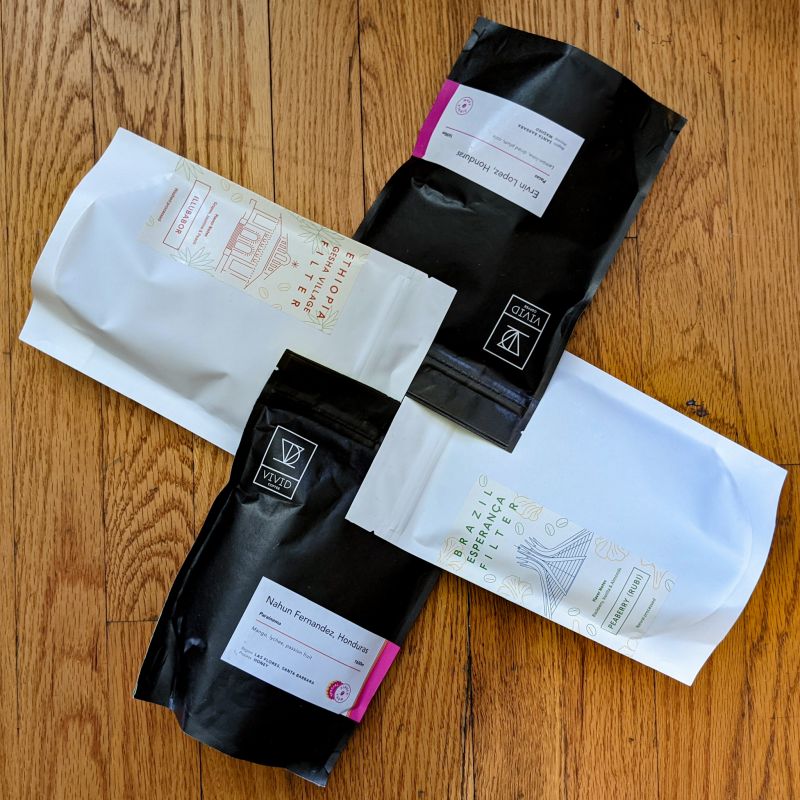
I think the time has come to stop writing an introductory excerpt about my long, arduous journey to finding the roasters I’m using each month. Beginning to feel like a foodie blog. No kale risotto here. Even though this is an intro. Whatever. Here are the coffees this month:
- April Brazil Esperança – The first Brazilian coffee to grace our presence in the history of Stimulus! This is a farm that April works with directly and also was the first Brazilian coffee that I ever served at Purple Llama. Throughout my entire specialty coffee career, coffee from Brazil was basically frowned upon. Now in the year 2021, Brazil is an origin I could not be more excited about. The potential in this country from decades of being the biggest producer of coffee in the world is coming together with the specialty coffee movement in a great way. Farmers are making progressive moves with their land and processing in new ways. What drove me to this coffee specifically for this month was the fact that it is a peaberry Rubi. I have not had a peaberry from Brazil ever and Rubi is a hybrid varietal grown only in Brazil. Also, a varietal I have not experienced. This coffee tastes like no other Brazil I have ever had. Even the “Good Brazils” still have some of that nutty, peanut note. This coffee is super clean and fruity. No earthy notes either. I tasted hazelnut, cardamom, red grape, and strawberry preserve. This was still a very “April” coffee so these flavors are pretty delicate, yet come together to create a super smooth and crushable cup. I brewed this coffee with a 15.5:1 ratio, with a grind size slightly coarser than a standard washed Colombia grind setting. I poured three pulses following my bloom, each spaced out by 35 seconds. I finished pouring at 2:05 and my drop time was 2:55.
- April Ethiopia Gesha Village (Washed Illubador) – Sorry to get your hopes up, this in not in fact a Gesha coffee. It is however from the Gesha Village Coffee Estate in western Ethiopia. The story behind Gesha Village is beautiful and I encourage everyone to read more about it. April typically buys several lots from Gesha Village each harvest and I always try to get my hands on as much of it as I can. The classic Gesha notes of jasmine and big sweentess paired with the native coffee terroir gives birth to great coffees. Again, this coffee is not a Gesha varietal though. The varietal is Illubador, a varietal I don’t know a ton about. However, from perusing the webs I am pretty sure it is a wild-grown varietal from the region that the people from Gesha Village decided to grow. It is a Gesha-like varietal found in the surrounding Gori Gesha forest around the estate. This coffee is stunning. First sip hit me with a caramel butterscotch berry blast. Following said blast, I got hit with rose, cabernet, honeysuckle, and meyer lemon. I brewed this coffee with a 15:1 ratio, with a COARSE COARSE COARSE grind setting. I can’t really give a good descriptor for how coarse because of just how coarse it was, but on a normal Baratza I would go 5-6 clicks coarser than usual, and 3 clicks coarser on something like a Porlex (much bigger steps). I slowly poured two pulses as to not agitate the fines too much causing the flow to stop up, finishing my second pour 2:10. My final brew time was 2:50. This is a truly delicate and intricate coffee so I probably won’t experiment too much with coarser grind/more pulses, but instead will enjoy how it develops in the coming days/weeks.
- Vivid Honduras Nahun Fernandez – I am amazed at how closely Vivid has been working with Honduras in the past year. Vivid’s owner Ian has visited multiple farms in Honduras and has established relationships with producers I wouldn’t have ever heard of otherwise, and that kind of work is what keeps me interested in coffee. This coffee is a honey-processed Parainema, another newer varietal for me. According to Ian, it typically is grown in Honduras for a more citrusy profile. With the honey process, it creates a sweet, fruit-forward cup. Nahun Fernandez’s farm and processing station are shared with his brothers and father, where they are able to pool their knowledge together to produce exceptional coffees. Nahun began working with a huge Australian (and now global) roaster called Proud Mary a couple years ago, which has helped him become even better as innovative processing techniques and new varietals. I look forward to trying more coffees from here, especially roasted by Vivid. The first sip blew my mind. All the flavor hit me in waves, with the final wave (what one might call aftertaste) was the best one. It was like a mango lassi. This coffee overall had big flavor. I tasted boysenberry syrup, orange, black cherry, and as mentioned, mango lassi. I brewed this coffee with a 16:1 ratio and since this is a honey processed big bean, I knew it would drop out quick. I ground it a couple clicks finer than usual, and poured four pulses spaced out by 30 seconds. I finished my fourth pour at 2:30, and the drop time was 3:00. I will also experiment with a 16.5:1 ratio and trying to extend the total brew time to see what other flavor lies in this bean.
- Vivid Honduras Ervin Lopez – I am BEYOND thrilled to share this one with everyone. Last year when I first tried this coffee, it was on a cupping table with a couple other roasters that I actually knew (Vivid was unbeknownst to me at the time) and this coffee was the best one. It made the decision of choosing Vivid and this specific coffee so easy. The lemon acidity that punched through the cup was like nothing I had ever had from Honduras. It still had that complex sweetness that I love from the Santa Barbara region. Ervin Lopez has a very small lot to plant trees on – less than half of a hectare, which is filled with exclusively Pacas. This plot was given to him by his father, and now he produces, picks, harvests, and processes all the coffee on site with his wife. As far as google shows, Vivid is the only roaster that uses his coffee. Just like last year, Ervin Lopez’s coffee is great. I tasted less lemon, but more sweetness. I got a lot of lime, red tea, and molasses. This is at the same time a crowd pleaser, and also a delightful, intricate beauty. I brewed this coffee with a 16.3:1 ratio and ground it barely finer than a standard starting grind size. I poured three pulses spaced out by 40 seconds, finishing at 2:10. My drop time was 2:50.
 Stimulus Coffee Club
dont know if i can take the heat of this fire…..cant wait
LikeLiked by 1 person