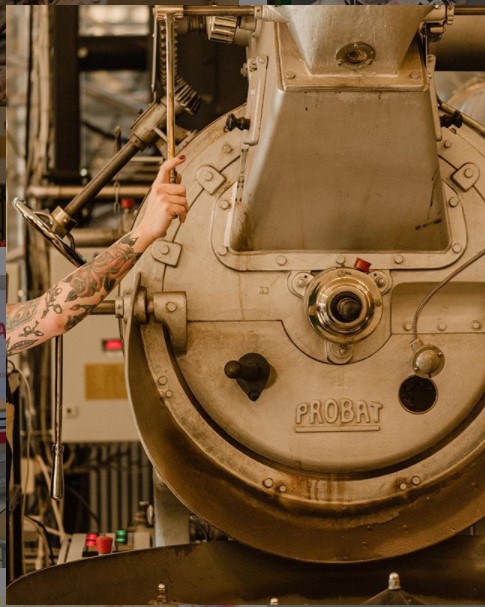
October is the best for a couple reasons: the trees turn and become a form of earth art vibrant with an autumn palette, the month ends with the most important holiday, and last but not least, it is prime coffee sipping weather. This month we are drinking coffees from Kaffa from Oslo, Norway. I am not sure how many of you are familiar with Kaffa, as they were not a common roaster in the shop and hardly anyone in the United States sells them. They are a large roaster and, unlike the other Nordic roasters we enjoy, they use an older roaster called a Probat. Some argue that the roaster the others use, called a Loring, produces cleaner coffees with greater consistency. But roasters like Kaffa that do not use this newer, more techy/advanced roaster make me question that argument because their coffees are always clean and pop with flavor. Regardless, lets get in to the offerings!
 |
| Probat roaster at Kaffa |
1. Indonesia Waerebo Apen
I am so excited about this coffee! I have not had a great coffee with these clean flavors in years. To preface with a quick geography lesson: the Pacific Rim include but are not limited to Indonesia, Sulawesi, Sumatra, and Papua New Guinea. While I was with Sump Coffee we purchased coffee from Sulawesi for a couple years and they were fantastic. Recently, for some reason the coffees from Sulawesi dropped in quality and/or production so I wasn\’t able to find them anywhere. Furthermore, I\’ve been only able to find one or two good coffees from Sumatra and Papua New Guinea. Hence why this Indonesia coffee is basically the reason we are drinking Kaffa this month. The Waerebo Apen is a honey-processed yellow bourbon coffee from the Waerebo region, where one of the oldest communities in Indonesia is located. The coffee produced here helps the community run sustainable agriculture and helps coffee producers with innovation and growing micro-lots in the varying climates of this region. The flavors in this coffee are intoxicating. It is the most complex coffee I have had in a long time, with flavors of dried fruit, sour candy, chocolate, and honeycrisp apple. I brewed this coffee with a 16:1 ratio, and ground it at my normal starting point for a Colombian or Ecuadorian coffee. I used three pulses spaces 10 seconds apart, finishing my last pour at 1:50. My final brew time was 2:50.
2. Ethiopia Yirgacheffe Chelbesa
The Ethiopian coffee season is coming to an end soon. In the coming weeks, we will see less and less fresh crop Ethiopia coming in and most Ethiopians remaining will be late-season or leftover. This delightful washed Ethiopian is from the Negusse Debela processing station, which receives coffees grown in \”semi-forest\” conditions. While we do know the main varietals grown in this region and processed at this washing station are Dega and Wolisho, we will never know for sure if that\’s it as transparency in Ethiopia is difficult. However, these natural varieties produce wild flavors not known elsewhere in the world…one of the reasons we will always love Ethiopian coffees. In this coffee I tasted explosive citrus and stone fruits. Bright tropicals hit right away, then turn to juicy peach and florals, with a spiced orange tea aftertaste. I brewed this with a 15.5:1 ratio and a coarse grind setting to achieve a faster brew. Personally, I used a smaller dose so I went for a 2:20 brew time with two pulses separated by 10 seconds, finishing my pour at 1:30. If you are making a larger batch, I would just recommend going much coarser than usual and adjusting your pour or grind setting to get this to taste better. If it tastes weak, you probably have gone too coarse or poured too fast.
3. Uganda Mbale
For years, Uganda has primarily produced a lot of low quality green, which kept income and quality low. This is changing. I chose this coffee because I think specialty coffee development in Uganda is extremely important to support their economic efforts. While most of the current coffees from Uganda are naturals, such as this one, I look forward to how the processing progresses in the years and would warmly welcome another country to my \”favorite origins\” list. This month\’s offering specifically is a natural semi-anaerobic coffee. While exciting on it\’s own, that is not even the best part. The varietals are SL28, SL34, and SL14, which are all typically Kenyan varietals. This lot comes from the Sironko processing yard located in the Mbale area in Eastern Uganda. In this coffee I tasted a hit of funk right away, but it is fleeting. The cup quickly transforms in to a delicate, yet sweet cup with a long sticky sweet aftertaste. I tasted fermented blueberry, graham crackers, lavender, with a coating yet silky body. I brewed this one with a 16:1 ratio and ground it a couple clicks finer than my usual starting point to give me a 3:00 brew time. I would do 3-4 pulses to achieve this brew time.
Thank you again for allowing me to bring wonderful coffee in to your home and allowing me to continue supporting these roasters working so hard to create a better world for coffee to thrive in.

 Stimulus Coffee Club
I am really enjoying these Kaffa coffees especially the Mbale. I think it is one of the best coffees I've had this year and maybe the best. It's smooth, definitely with hints of blueberry but also a richness. Just fabulous coffee. Thank you so much Dylan
LikeLike