

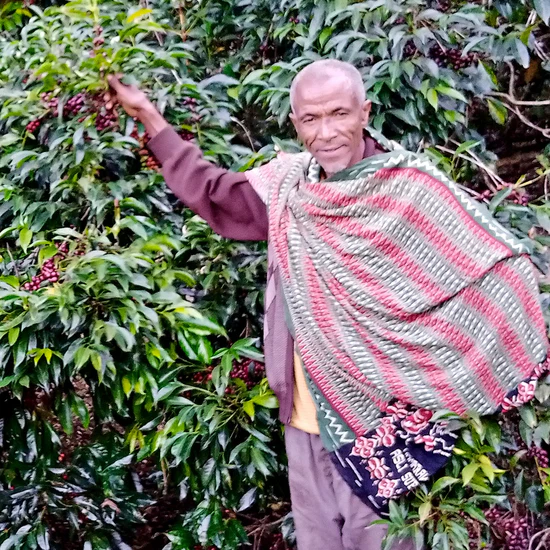
A Matter Of Concrete Ethiopia Arsosala – It has become this roaster’s goal to have a delicious washed Ethiopia on the menu consistently, as it tends to be most coffee people’s favorite profile and just a classic coffee to always offer. This one stems from the Single Farmer Project, a program that allows roasters to connect with single farmers in Ethiopia, rather than buying from mega co-ops and washing stations. There are pros and cons to each in my opinion, but that is a story for a different day! This coffee comes from Mr. Ocholo Bedecho, a farmer in the Guji region. The coffees are grown at 1800-2000 MASL, which is considered relatively low for this region. Bedecho’s farm is about 8 hectares, and mixed heirloom varietals are grown. I taste herbs, lime, clove, and some bergamot on the finish. I brewed this with a 16:1 ratio and ground it seven clicks coarser than my typical starting point. I poured two pulses spaced out by 45 seconds, finishing my second pour at 2:00 for a 2:45 final brew time.
A Matter Of Concrete Colombia Daisy Acevedo – Not to be confused with the famous Acevedo region, which this is not in! This washed Gesha comes from Daisy Acevedo’s farm, El Encanto. The farm is located in Quindio, a department just west of Bogota. The region is famous for tourism and it’s mountainous terrain. The farm is located at 1900 MASL, and is described as a breathtaking landscape located on the edge of a nature reserve. Coffee trees are grown under native shade trees on the farm, and the Acevedo family has invested in newer processing equipment that allows much more precise control over the fermentation stages. The cherries were harvested at a slightly overripe stage and rested for 24 hours. After depulping, the seeds are fully washed, and then dry-fermented for 48 hours. This one is even brighter than the washed Ethiopia that was shipped along with it! I taste lemon balm, jasmine, sweet corn, just elegant. I brewed this with a 15.8:1 ratio, and ground it one click coarser than my typical starting point. I poured three pulses spaced out by 40 seconds, finishing my last pour at 2:30 for a 3:15 final brew time.
Little Wolf Peru Rogel Segovia – This coffee comes from the Aromas del Valle co-op in Cajamarca, Peru. This is a 100% washed Typica variety grown at 1750 MASL. The team at Aromas del Valle partnered with the Progreso Foundation to bring a better model of local farming support to the operation. The Progreso Foundation helps with not just coffee farming but other trees and vegetable crop as well to help the farmers create better livelihoods. Organic coffee farming has always been huge in Peru, and the foundation assists the farmers with organic practices to keep chemical pesticides and other fertilizers away from the coffee production. I tasted Black Walnut, Orange, and Cane sugar. Sweet and delicious, exactly how I love a washed Peru. I brewed this with a 16.5:1 ratio, and ground it one click finer than my typical starting point. I poured four pulses spaced out by 30 seconds, finishing my last pour at 2:45 for a 3:40 final brew time.
Little Wolf Colombia YCA – YCA is a program in Antioquia, Colombia that stands for “Young Producer Program”. YCA’s goal is to support the younger producers in the region who have chosen to grow specialty grade coffee and produce it with passion and drive. The program seeks to highlight the young producers with smaller lots by guaranteeing quality control and consistent, year-round availability of their crop. This lot in particular is a blend of many small holding producers who produced high quality lots of Caturra, Castillo, and Colombia. They were grown between 1800-2000 MASL. This extended fermentation means that instead of typical 24-48 hours of wet fermentation, it went on for much longer; I can guess maybe 100-200 hours as I’ve seen in the past, but this number is not published for this lot. This is an absolute fruity funk bomb. I tasted starfruit, papaya, and green apple. I brewed this with a 16.3:1 ratio, and ground it two clicks finer than my typical starting point. I poured three pulses spaced out by 40 seconds, with as wide of circles as I could manage. I finished my last pour at 2:10 for a 3:00 final brew time.
 Stimulus Coffee Club