

Junto Rwanda Inzovu Peaberry – This coffee is a natural rendition of the washed peaberry from the Inzovu washing station we had earlier this year. Overall, the cup has similarities, however this one has a bit more of a punch brought out by the natural processing. This is a small washing station that pools small lots together from farmers that have coffee gardens around Lake Kivu in the Nyamasheke district. The coffee gardens range from 1400-1900 MASL. Inzovu is a subsidiary of the Rwandan Trading Company (RTO) that works to encourage and promote smaller Rwandan coffee farmers, and provides funding and education to improve quality and train the community on what it takes to produce specialty coffee that Rwanda has become so famous for in their bright juicy profiles we have all come to appreciate. In the cup I tasted lime and plum, with maple on the finish and a creamy body. I brewed this with a 15.7:1 ratio and ground it one click coarser than my typical starting point. I poured two pulses spaced out by 45 seconds, finishing my pour at 1:50 for a 2:50 final brew time.
Junto Nicaragua Finca Misericordia – This is my first coffee from Misericordia, and also my first Nicaraguan Parainema. I am glad to see the varietal shifting through borders and making its way through Central America. It is a high quality, disease resistant varietal that has created awesome coffees from low and high elevations. This is a family-owned farm located at 1350 MASL and has been in the Blandon family since the 1960s. It is now operated by Alvaro Blandon, the grandson of Zacarias Blandon, who was the first to start cultivating the land. The region of Jinotega in northwest Nicaragua is characterized by lush forests and volcanic soil. The Misericordia farm has worked on setting up direct partnerships with roasters in the US and has even opened up their own cafe in Orlando. This coffee is a classic Central American honey process with big time sweetness and subtle funk. I tasted tart cherries and raisin. I brewed this with a 15.5:1 ratio and ground it three clicks finer than my typical starting point. I poured four pulses spaced out by 30 seconds, finishing my last pour at 2:30 for a 3:05 final brew time.
A Matter Of Concrete Guatemala Las Brisas – Las Brisas is a farm located just east of the capital, Guatemala City, in Mataquesquintla. Las Brisas is located at 1800 MASL and is operated by the owner, Marvin Carias. Marvin has owned the original piece of land since 1990, and has slowly added to the plots as the farm became more profitable and has implemented techniques like shade trees and replanting old varietals and trees from the beginning. Marvin continues to be inspired by the local community and what coffee has done for them, and regularly reinvests into better water systems and supporting community projects. This is a washed Caturra, meaning it was pulped and then wet fermented for 12 hours, then washed and dried on raised beds. This is just the definition of a “nice coffee”. Sweet rounded flavors like chocolate and walnut come together with a hazelnut aroma. Perfect every day cup that will develop nicely as it develops farther off roast. I brewed this with a 16.0:1 ratio and ground it right at my typical starting point. I poured three pulses spaced out by 35 seconds, finishing my last pour at 2:30 for a 3:10 final brew time. I recommend at least a 45 second bloom on this one.
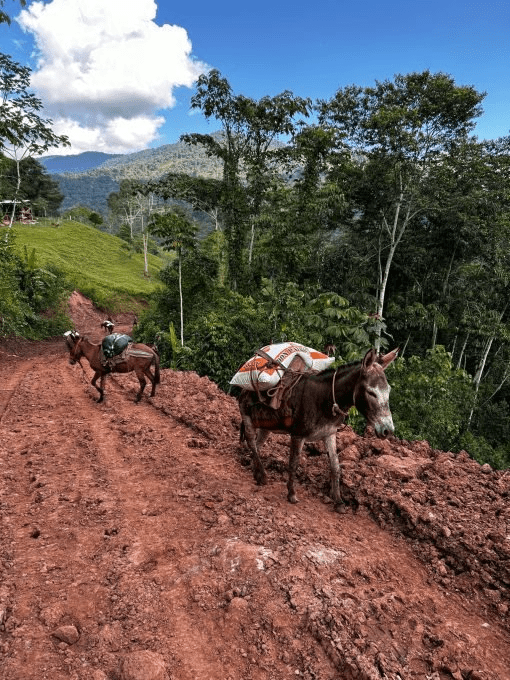
A Matter Of Concrete Peru Herlin Gesha – A gesha in the subscription! In this economy? This one comes from Herlin Encarnacion’s farm, Nueva Zelandia. The Nueva Zelandia farm is located deep in the jungle in the Huanuco, 8 hour car ride from the city of Huanuco and located at 1650 MASL. Herlin has been in coffee for 20 years, and only planted gesha in the last couple years. The first few harvests seemed to be a struggle, with this harvest being one of the first that went to market. It is a typical washed process that we typically see in Peru. This is not a typical floral and fun Gesha profile I am noticing. This is a nice coffee, and I would probably most closely compare it to a really high quality Colombia that has slightly more uniqueness than what I would find in a typical Peru. I tasted geranium and juniper, with a slight woodiness that more “stems” from the herbaceous notes of the cup. Very herbal liquor, very cool. I brewed this with a 16.3:1 ratio, and ground it one click finer than my typical starting point. I poured three pulses spaced out by 35 seconds, finishing my last pour at 2:15 for a 3:05 final brew time. I recommend a shorter bloom on this one around 30 seconds.
 Stimulus Coffee Club