

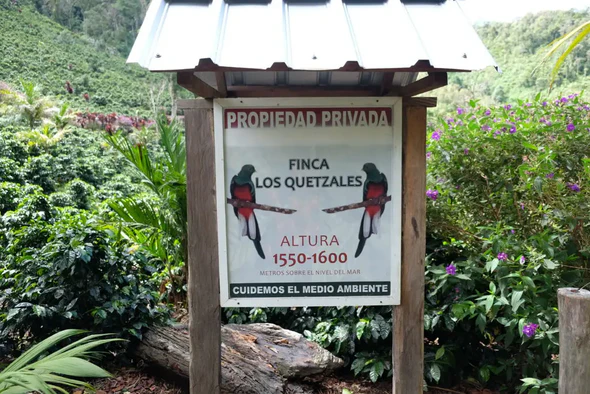
Kaffibrugghusid Honduras Los Quetzales – This farm is located in Santa Barbara, Honduras, owned and operated by Pedro Sagastume. Los Quetzales has been operating for decades, and at this point, Sagastume has split the land in to multiple plots for his kids to operate. This specific coffee comes from Don Pedro’s plot, and is a Pacas grown at 1600 MASL. This lot also comes after the farm’s purchase of new solar dryers, purchased along with recent investments by the farm to bring the processing operation in to the future. The coffees are first pulped and then dry fermented (in mucilage) for 16-24 hours. The coffee is then washed and then dried on the solar dryers for 14 days until specific moisture content is reached. I tasted Applesauce, candied ginger, macadamia, with a smooth, sweet, cacao finish. This is a super mild, light, and delicious cups. I brewed this with a 16.2:1 ratio, and ground it one click finer than my typical grind setting. I poured four pulses following a brief 35 second bloom, spaced out by 30 seconds. I finished my last pour at 2:35 for a 3:25 brew time.
Kaffibrugghusid Kenya Kiandu AA – The Kiandu factory is part of the Nyeri growing region, part of the Mutheka growers society. The society has 6,000 active members consisting of small scale coffee farmers and mill workers. All cherries are delivered to the coffee clerk at Kiandu, where they are checked for defects and ripeness. I am told this coffee clerk is a tough one and regularly rejects crop due to issues. All ripe cherries are then pulped and then fermented for 12-48 hours depending on the outside air temperature. The seeds are then removed and dried for 2-3 weeks. I have hardly had any Kenyan coffee this year, I believe due to quality but also scarcity. This is a nice reminder of what it can be, and hopefully more of what we can get next year. I taste rhubarb, molasses, and black currant with a creamy and full mouthfeel. I brewed this with a 16:1 ratio, and ground it three clicks coarser than my typical starting point. I poured two slow, long, drawn out pulses spaced out by 50 seconds, finishing my second pour at 2:10 for a 3:00 brew time.
Junto Brazil Vinhal MK-12 – The first ever Brazil from Junto is here! I had to jump on this right away, knowing it was on the way based upon a talk I had with Junto several months ago. This is a “direct trade” coffee with Rafael Vinhal, who owns and operates the estate this coffee comes from. This is a Catucai Peaberry mutation grown at 980 MASL, taking the increasingly popular Brazilian Catucai varietal to new form (literally tho). As the bag states, this coffee underwent natural fermentation two times. First, in an open fermenter for 44 hours. The whole cherries are removed and undergo thermal shock to halt fermentation. Then the cherries are fermented anaerobically for 129 hours. After another cold thermal shock to stop fermentation, the cherries are then pulped and cleaned before drying on raised beds. No way is this what I would refer to as a standard Brazil profile. It takes hints from northern neighbors of Central America with an extra punch of sweet nougat and papaya, with pomegranate tartness. I brewed this with a 15.8:1 ratio and ground it two clicks finer than my typical starting grind. I poured three pulses spaced out by 35-40 seconds following a long 50-55 second bloom. My last pour finished at 2:30 for a 3:20 drop time.
Junto Colombia El Paraiso Rose Tea – Finca El Paraiso is the brain child of coffee genius and all around coffee superstar Diego Bermudez. Considered one of the most innovative coffee producers in the world, Diego Bermudez is always going to be a super exciting name to see on the coffee you are drinking. The coffee is a Castillo grown at 1900 MASL. After harvesting, the cherries are disinfected under ozone and then transferred to the fermenters to ferment anaerobically for 48 hours. Once removed, the yellow fruit yeast cultures are introduced with the pulped cherries and fermented for an additional 24 hours in open air fermenters. Diego loves the thermal shock once the fermentation is finished, so the cherries hit the cold water before being completely washed and laid out to dry in a room with a dehumidifier to create the exact moisture content that was expected and planned for. This coffee smells like straight up peach juice, and on the first sip it was actually rose or rose hip tea, hence the name. It smells and tastes exactly like passion fruit juice. The profile is crazy and I have not had a coffee quite like this in my life. I brewed this with a 16.5:1 ratio, and ground it two clicks finer than my typical starting point. After a 35 second bloom, I poured four pulses spaced out by 30 seconds, using heavy and wide pours. I finished my last pour at 2:30 for a 3:05 brew time.
 Stimulus Coffee Club