

Kaffibrugghusid Colombia El Obraje – What drew me to the Obraje was mainly the elevation. This full Caturra lot was grown at 2200 MASL in Narino which isn’t insane or anything, but definitely higher than average for the region. El Obraje is the name of the farm by Pablo Guerrero. Hacienda El Obraje has been in Guerrero’s family for generations but was not traditionally a coffee farmer. Originally, wheat and other grains were grown in the 90s before moving on to more fruits and then eventually coffee in 2000. He started with commodity and was doing nothing groundbreaking with coffee, and after several years of this, grew a processing station and started focusing more on quality and better varietals. The elevation and soil quality has made the property almost perfect for growing coffee. The cool temperatures and volcanic soil are what really help coffee thrive. After harvesting, the cherries are left to ferment for 20 hours in the same sack that the pickers use. The cherries are then floated for defects, and wet fermented for 24 hours. The coffee is then fully washed, and floated again for extra defects. Drying is usually 16 days. Right away I tasted a charred oak note with green apple acidity and honey sweetness. I brewed this a bunch of different ways and the same basic profile came back each time. Be careful with the brew on this, as a quicker drop time gives it some slightly cardboardy notes. I also raised my average brewing temperature from 93C to closer to 97C to help extract everything out of this coffee. I brewed this one with a 17:1 ratio and ground it two clicks finer than my typical starting point. After a 50 second bloom, I poured three pulses spaced out by 40 seconds, and poured fairly wide circles to slow down the brew. My third pour ended 3:00 for a 3:40 brew time.
Kaffibrugghusid Ethiopia Konga – Konga Washing Station… Iconic. The Konga Village is located in Yirgacheffe, and the Konga Washing station was established in 2002, with the goal of bringing out the beautiful wild coffees of the region to the rest of the world. The washing station processes cherries from nearly 1200 smallholding farmers. Because of the staggering number of producers, there will rarely be a specific varietal tied to the coffee that comes from here unless it is for a specific lot. The elevation in this region averages 1925 MASL and the cherries are processed in the traditional Natural process for this station. This is an old school tasting Natural Ethiopia. Sort of a blast of ripe blackberry, heavy red wine, and tart cherry. For my brewing temperature like with the Obraje, I used a higher temp of about 96C. I brewed this with a 16.5:1 ratio, and ground it 6 clicks coarser than my typical starting point. I poured two pulses spaced out by 45 seconds, finishing my last pour at 2:10 for a 3:00 brew time.
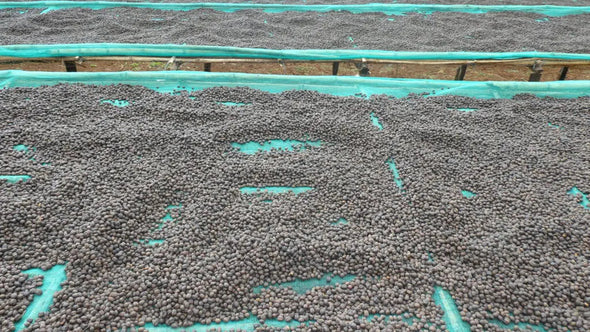
Manhattan El Salvador Carlos Mendez – This is not the first time with Mr. Carlos Mendez! We had coffee from Carlos last November roasted by Manhattan and I have to say the quality has improved. This lot is 100% Pacamara, one of my favorite varietals and is grown from 1350 MASL. Carlos Mendez has won multiple Cup of Excellence awards and is famous for the work in Ahuachapan region, bordering Guatemala. This lot is a double fermentation natural, meaning after harvesting the cherries are gathered and fermented openly for 24 hours and then fermented anaerobically for 24 hours. The coffee is then slow dried for 40 days. Manhattan actually commissioned Mendez to produce the coffee this way for a competition last year and it turned out so well that they are standardizing this for Manhattan’s contract coffee. Yeah so kinda throwing a dart at the flavor wheel here… But this cup is wildly complex. In the brewing bed I was smelling like yellow bell peppers and white chocolate. The actual cup has some of that savory quality in the form of oregano or pesto. It sounds bad but it somehow worked. The sweetness was excellent and was kind of reminiscent of the yellow bell pepper that I had smelled. I love this cup but I shouldn’t. If you want to make an absolutely dreadful cold brew, this would hit the mark for you. I ground this coffee one click finer than usual and used a 16.2:1 ratio. I poured four pulses spaced out by 35 seconds, finishing my last pour at 2:30 for a 3:20 drop time.
Manhattan Tanzania Edelweiss – This exciting sparkly guy comes from the Gaia farm in Tanzania, a member of the Finagro Farms collective. The farm is owned by the Vohoras, a multiple generational farm sprawling 1000 acres on the southern slopes of the Ngorongoro conservation area on the edge of a crater. The farm is located in a valley and the Vohoras provide a Rainforest Alliance Certified farm and it provides temporary housing to the seasonal harvesters. I love coffee from Tanzania but I have not seen a lot of variety in the varietals. Not a lot of variety-als? Sure. This one however is a mix of not only Kent but Red Bourbon, and SL28. This is my first coffee from the Gaia farm but I look forward to trying more, especially as Manhattan pushes them to experiment with fermentation. This was definitely my favorite cup… I tasted red fruit like cherries and strawberries with a nice herbaceous quality. I brewed this with a 15.8:1 ratio, and ground it 3 clicks coarser than my typical starting point. I poured three pulses spaced out by 35 seconds, finishing my third pour at 2:10 for a 3:05 brew time.
 Stimulus Coffee Club