

We have a new friend this month from a small town called Odder near Aarhus in Denmark. I found this roaster through a subscription that I am a part of which I mainly use to find new roasters. This is the first time it has worked! What amazed me about them was their Brazil. I am much more open-minded now but it wasn’t until a couple years ago that I really started to realize Brazilian coffees potential. If a roaster has a truly delicious Brazil, that means their other coffees are probably roasted extremely well as a Brazil is a difficult coffee to roast in a high-level specialty setting. I did not provide the Brazil from them this month to everyone as it is still a Brazil and would not fit everyone’s preference profile but I hope those who did, find the joy in it that I did. I am really happy to be bringing Clever over and sharing it with everyone, the brewing recipes were slightly different for these ultra-light hotties so read the brewing instructions carefully.
Colombia La Pradera – This is not the first coffee we have had from the La Pradera farm in northeast Colombia. The profile from this farm generally fits within what I consider the high quality Colombia profile, aka WORLD fuckin CLASS. La Pradera is owned by the Deza family, started by Hector in 1979. The farm has been passed down through the family and Oscar is the new Don. In order to give the look of a high-level farm, Oscar sought after certifications. One being Organic, which doesn’t really mean anything as all of the coffee in the subscription is technically organic just without the certification. But also, certified bird friendly! Basically this means using shade trees planted between coffee trees. Most specialty farms do have shade trees, as this better controls the sun exposure and helps with longevity of the trees. Also for the birds. This is a honey-processed Tabi grown at 1700-1900 MASL. The Tabi varietal is highly resistant to leaf-rust and can be tricky to yield a high quality cup. The flavor profile in this cup is unusually more vibrant when it is freshly brewed and super hot. I typically wait to get true tasting notes from a cooler cup but I hereby provide the rare recommendation to guzzle this stuff right down. I tasted cranberry and rosemary right away, followed by rhubarb and pear. I brewed the La Pradera Tabi with a 15.5:1 water to coffee ratio and ground it three clicks finer than my typical starting point for. With the finer grind, I poured two long pulses starting at 40 seconds, and the second at 1:40. The total brew time was 2:53. The point here was to use a fine grind and quick pours to maximize the brightness here, as a coarser slow pour here would have provided more of the sweeter compounds that honestly weren’t all that great.
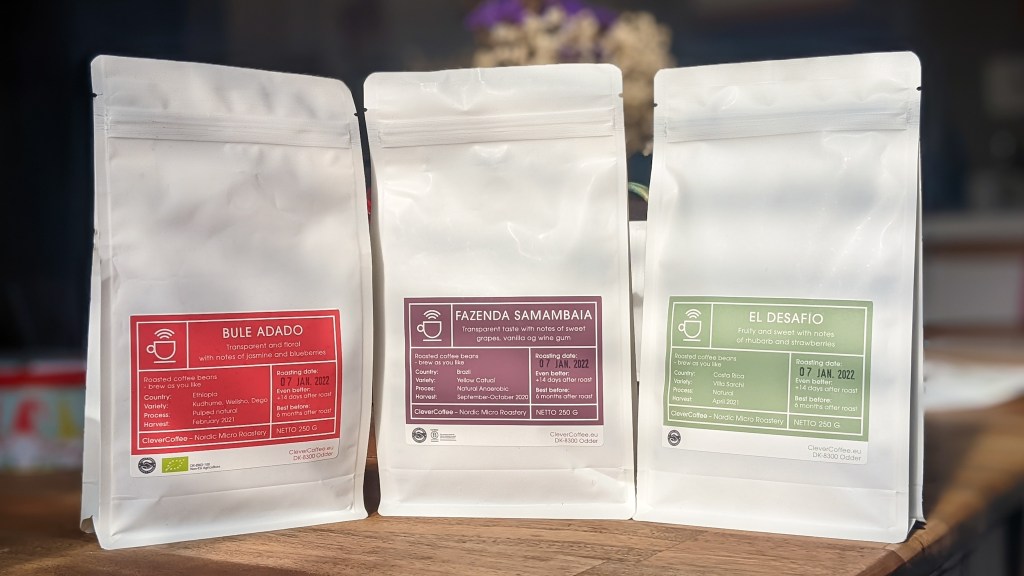
Ethiopia Bule Adado – I knew this was going to be bonkers when I read the name. Adado is absolutely one of the best processing stations in Ethiopia. The bag says pulped natural, which really just means honey processed. In Ethiopia and Brazil they use the term pulped natural instead of honey, and it is actually a much more accurate term. I don’t know how many times I have had to tell customers that no actual honey was used in the processing. Adado station is a pooled lot from various smallholders in the region, and demand that none of the growers use pesticides in the growing. This obviously would be hard to prove but is an important ethical distinction. There are three noted varietals here – Welisho, Dego, Kudhume. The elevation ranges from 1700-2200 MASL, a range so wide it isn’t even worth knowing. This was the most obviously vibrant and exotic coffee I received from Clever. Each sip had me gasping for air; I would have believed it was a Gesha if someone told me. When hot, I got a lot of florality and orange blossom. It had a sort of Earl Grey/Bergamot flavor as well which had me start thinking it was a little bit Burundi-esque. I also wrote in my notes “Banana!” so I guess we can throw that in the pot. I brewed this with a 15.3:1 ratio and ground it six clicks coarser than my usual starting point. I poured two fairly quick pulses but spaced them out by 40 seconds, finishing my pout at 1:40 for a 3:00 brew time. This one had a super long draw down time which I think is required for these super light coffees to extract all the flavors out of them fibers.
Brazil Fazenda Samambaia – Alas, the one I keep talking about. This is a natural Anaerobic Yellow Catuai grown at 1200 MASL. Do not get all hype boy on me about the Anaerobic part here though, a lot of coffees in Brazil are anaerboic in the specialty world but they do not have the same pop as the other Anaerobics we see here. Not shitting on this coffee at all though. This varietal is so special in Brazil, most of the highest level specialty coffee I have enjoyed in the last few years (like only 3-4 lol) are yellow catuai. This yields a clean cup with soft reminders of the country this bean was grown in, but not overwhelmingly earthy or nutty. The producer is a new one for me, his name is Henrique Dias Cambraia. When he took over the farm from his father who dual-careered as a Coffee Farmer and a Medical Doctor, he wanted to transition the cash-cow commodity farm to a more sustainable model, producing consistentf varietals that will be delicious year after year. Long-lasting trees, picking ripe cherries, maintaining a strong staff by treating them well and creating great working conditions. The reason for loving this Brazil so much is because it did not taste as much like a Brazil. I would put it on par with one of my beloved Kafferaven Nicaragua lots actually. The big fruit notes and the dry earth played together so well. I could taste a small amount of ferment but it actually kind of worked with the fruit. I tasted chocolate covered strawberries right away, followed by cantaloupe and raisin. I brewed this one kinda weird… so there is NO BLOOM. I did two identical pulses starting at 0 seconds. Don’t ask me what led me to this – the voices of my ancestors told me to do it. I poured heavy, wide circles for these. Each pour was about 30 seconds, and I took a 20 second break between pours. The final brew time should be at least 2:25. I used a 15.8:1 ratio with a grind size two settings finer than usual. You can of course try any method you want for this one but with this method I got the most clarity.
Costa Rica El Desafio – This small lot comes from Cafe Rivense in the Chirripo region, near Chirripo National Park and Forest. This is a Natural process Villa Sarchi grown at 1550 MASL. I love the Villa Sarchi so much as it always is deeply complex and when roasted correctly, the flavors are wild. Cafe Rivense is owned by the Rojas family, started by the parents over 30 years ago and now run by the kids. Similar to the Brazil above, the kids took over and wanted to change the business model to a specialty market. They used techniques like new experimental varietals, reusing coffee mucilage waste as a natural fertilizer. El Desafio means “The Challenge” which is named for the struggle the family went through for trying to produce alternative-processed coffee. They have been experimenting with honey and naturals for many years now with many failed experiments. After failing so many times, this is the first natural the family has released and as a direct partner of Clever, they were able to purchase this first experiment. This was the one that stood out the most on the cupping table. I drew like a double-outlined star around it in the notebook. It has vibrant tropical flavors and tart cranberry notes. It was tricky to figure out how to brew but I knew the potential locked in those beans and kept at it. Once cooled it gets slightly funky but it also brings out more cherry. I brewed this one with a 16:1 ratio, and a grind setting one step closer than my typical starting point. I poured four pulses spaced out by 35 seconds finishing at around 2:30 for a 3:00 drop time.
 Stimulus Coffee Club