

Happy August everyone. This month we are trying coffees from Kafferaven Per Nordby from Gothenburg, Sweden. I love this roaster for many reasons – mostly involving the dedication to direct trade. All of Kafferaven\’s coffees are direct trade, coming from only a handful of countries to make sure the focus on producers is always there. With this business model, Per is able to guarantee the producers worked meticulously to produce superbly high quality coffees in a sustainable way, growing each year to make better coffees and create a healthier world. You might notice that all of the coffees were roasted earlier this month; this was something I intentionally made sure of to ensure the first cup of any of the coffees I chose this month were rested well enough. When I first started working with Kafferaven I noticed that unlike other roasters, the coffees NEED to rest for 10-14 days before drinking. So I saved you all the trouble and confusion of going through the gassy flavors that I initially went through in order to taste their full potential. Now let\’s talk about the coffees!
First up is the coffee that almost everyone received – Kenya Gachuiro.
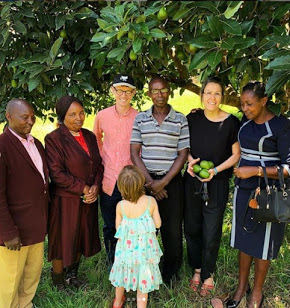
Per and his family with owners of Gachuiro factory
Earlier this year before the pandemic started, Per moved his family to Kenya for what was supposed to be six months, to build a stronger network of coffee producers with the wet mills and co-ops in Kenya. This trip had to be cut short due to travel restrictions. This coffee ended up being from one of the best washing stations Per met with and he became so impressed that he made sure to release this product first. Gachuiro is one out of four wet mills in Kiama cooperative located close to Karatina town in Nyeri. Gachuiro has 480 members, fairly evenly divided between male and female. Manager Ephraim and machine operator Leonard work close with the rest of the staff to ensure a high quality. Cherries are sorted and pulped the same day as picking. Fermentation takes 14-18 hours and water is circulated every 6 hours. Post-fermentation coffee is soaked 24 hours before being dried on tables for 10-14 days. Right away when I brought the cup to my nose I knew I was going to love it. So floral and sweet smelling. On first sip I tasted hibiscus, blackberry and other tart tropical fruits. I ground it slightly coarser than normal and used a 15:1 water to coffee ratio with just two pulses (30 s bloom, first pour from 30-50 s, second pour from 70-90 s) and a total brew time of 2:30.
The second coffee is Costa Rica Yemersons. This coffee has been around for a bit longer, but the profile is so clean and sweet. This coffee is more of a crowd pleaser – something your dark roast loving uncle might like but also something I can enjoy every day. It is a honey processed Catuai from the Yemerson family, a family that has been producing coffee for generations. The current farm is 32 years old and was created with the marriage of Yemerson\’s parents, as Yermerson\’s grandfathers, don Victor and don Julio, both had farms that they merged into one. He tells us they are also the source of Yemerson\’s passion. Yemerson built his micro-mill in 2018, and this coffee is his second export. I brewed this one with a 16.5:1 ratio to help clean up the full body. I ground it slightly finer than I usually start with and used three pulses (25-30 s bloom, first pour from 30-40 s, second pour from 70-80 s, third pour from 110-120 s) and ended with a 2:45 brew time. This created a rich cup with a lot of caramel, brown sugar, banana, and a soft floral finish.
Next, the Burundi Nyinya. Nyinya is a natural processed 100% Bourbon coffee from a group of growers in the northern province of Ngozi. More than 1533 farming families from 20 nearby coffee hills deliver their cherries to Nyinya. While women make up only one third of the producers who contributed to this coffee, they are without question the thread that holds coffee farming communities together in Burundi. They work incredibly hard; hand tilling the soil, growing, harvesting, sorting and hauling multiple crops, not just coffee. And they often do all of this with a baby on their back or a child at their hip. I brewed this coffee with a 16:1 ratio with a faster pour using two pulses (30 s bloom, first pour from 30-45s, second pour from 75-90s) and ended with a 2:40 brew time. The brew is wildly fruity, I don\’t even think I can articulate the flavors. The finish was all dark chocolate. I am sure as this one ages it will clean up.
Lastly, is La Picona. Not many people received this coffee as I am nervous getting people into Nicaraguan coffees. It takes a fairly specific palate, although not an advanced one, to enjoy them. I exclusively buy Nicaraguan coffees from Kafferaven, as their Nicaraguans are some of the best I have ever had. Also, not many other roasters I work with buy green from there as the quality can be a gamble. Per works with several farmers in Nicaragua and while I don\’t always find I like all of them, I usually am impressed by something. The chocolatey, tobacco flavors mixed with fruity undertones just make me smile. This coffee specifically is grown by Samuel Zavala in the Dipilto region, close to Honduran border. Zavala is known for his obsession with the Maracaturra variety, a large hybrid varietal crossed between Maragogype and Caturra. La Picona happens to be a Natural processed Maracaturra. I found this coffee to have some funk when hot. Not gross earthy funk, but some obviously fermented flavors that would not be for everyone, which is why I purchased so few bags of this. However as it cools a sweet tart flavor comes out with a cinnamon finish so definitely let it relax after brewing. I used a 16.5:1 ratio and had to grind much finer than the typical brew because of the incredibly low bean density (notice how the beans sound like sea shells?). I used three pulses for this one but next time I brew it I\’ll experiment going coarser and using as many pulses as humanly possible to get more sweetness and cut down earthiness. To extract more funk I would suggest extending the brew time longer, and for more clean fruit I would go finer and brew it faster.
Enjoy!
 Stimulus Coffee Club